What Is the Best Position to Sit After a Hysterectomy in Burleson, TX?
What Is the Best Position to Sit After a Hysterectomy in Burleson, TX?
Categories:

By: Ethan Cole
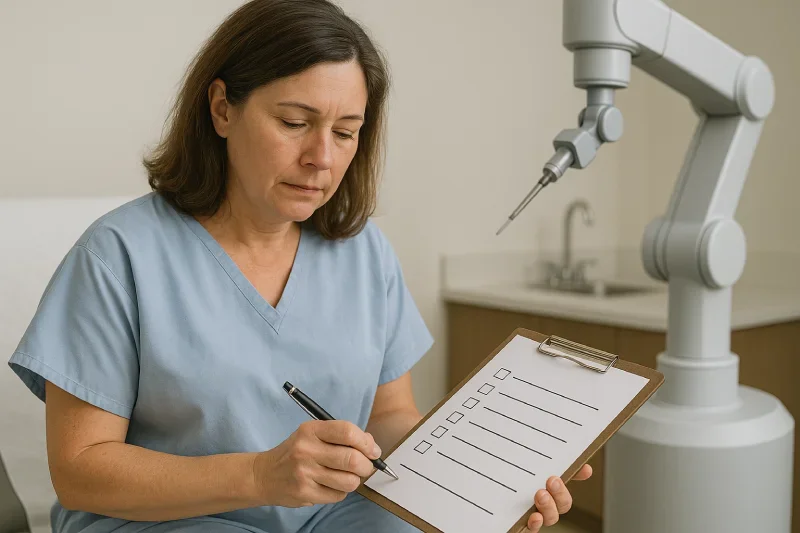
The best position to sit after a hysterectomy is upright or slightly reclined in a firm chair with armrests, hips level with or just above your knees, feet flat and a small pillow held against your belly. That posture keeps pressure off your incisions and lets your arms, not your abdominal muscles, lift you out.
Sitting sounds like the easy part of recovery, yet in the first few days it is often the part women find most surprising. Your abdominal muscles take part in almost every change of position, so a seat that is too low, too soft or too far back turns getting up for a glass of water into a strain on the very tissues that are trying to heal. For women recovering in Burleson and the wider Fort Worth area, where Dr. Neef's robotic hysterectomy patients usually go home the same day, that first afternoon in your own living room is when posture starts to matter.
The right position is not complicated and does not require special equipment, because a sturdy chair with arms, a recliner you can raise yourself out of and one or two pillows cover almost every situation. If you have questions about your own recovery, a board-certified gynecologist in Burleson, TX can tailor this advice to the surgery you are having, and the sections below draw on national guidance from MedlinePlus and ACOG.
In this guide, you'll learn why sitting position affects healing, which positions work best at each stage, how to sit down and stand up without straining, which seats and habits to avoid, and how to set up your car, desk and bathroom while you heal.
Why Your Sitting Position Matters While You Heal
Every hysterectomy leaves healing tissue in two places: the incisions on the outside and the area inside the pelvis where the uterus was removed. When you slouch, sink into a deep cushion or lean far back, your abdominal wall has to contract to pull you upright again, and that contraction tugs on both. An upright or gently reclined position that lets your hips and back carry your weight asks very little of those muscles, which is why it feels better and makes such a good default while you heal.
How much this matters depends partly on the kind of hysterectomy you had. According to MedlinePlus, the National Library of Medicine's patient resource, an abdominal hysterectomy uses a single incision of 5 to 7 inches in the lower belly, while a laparoscopic hysterectomy uses 3 to 5 small cuts. A larger incision is more sensitive to folding and pressure, so women recovering from open surgery usually need the supported position for longer. The kind of robotic gynecologic surgery now performed in Burleson tends to make sitting comfortable sooner, although internal healing still takes weeks.
There is also a circulation reason to take sitting seriously. The American College of Obstetricians and Gynecologists (ACOG) notes that walking soon after surgery helps prevent blood clots in the legs. The best sitting position is therefore one you leave regularly for short walks around the house rather than holding for a whole afternoon.
The Best Sitting Positions for Each Stage of Recovery
Most women move through the same sequence, starting with more support and reclining a little less as the days pass. The table below sets out the positions that tend to work best and what to watch for with each one.
| Position | Best Time to Use It | Why It Helps | What to Watch For |
|---|---|---|---|
| Slightly reclined in a recliner or propped on pillows | First few days at home | Takes weight off the abdomen while keeping your chest open for easy breathing | Use a recliner you can raise with a lever or button, not by sitting up with your stomach |
| Upright in a firm chair with armrests | From the first day onward | Hips at or above knee height turn standing up into a push with the arms, not a crunch | Avoid chairs so deep that your back cannot reach the backrest |
| Upright at a desk with lumbar support | Return to desk work, often after about two weeks | Supports a longer sit without slumping | Stand and walk briefly at regular intervals |
Keep your feet flat and roughly hip-width apart rather than tucked under the chair, because that gives your legs a stable base to push from. A small pillow behind your lower back helps you sit tall without effort. A second pillow held against your belly gives you something to press on when you move, a habit MedlinePlus recommends when you cough or sneeze to protect the incision.
The height of the seat matters as much as how soft it is. When your hips sit lower than your knees, as they do on most sofas, standing up means folding forward and curling your stomach. Hips level with or slightly above your knees let you simply lean forward and press down through the armrests. If your favorite chair is low, a firm folded blanket on the seat can raise you enough to make the difference.
How to Sit Down and Stand Up Without Straining
The movement in and out of a chair is where most of the strain happens, so it deserves its own technique that uses your legs and arms to do the work.
To sit down:
Back up until you feel the chair against the backs of both legs, so you are not reaching behind you.
Hold a small pillow against your belly with one arm and reach for an armrest with the other hand.
Bend your knees and lower yourself slowly, letting your arms take part of your weight.
Scoot back into the seat with small movements of your hips rather than one big push.
To stand up:
Slide forward to the front of the seat in small shifts until your feet are flat and slightly behind your knees.
Hug the pillow to your belly, lean your chest forward over your knees and place both hands on the armrests.
Push down through your arms and legs together, rising in one smooth motion rather than rocking.
Pause until you feel steady before you start walking.
Getting out of bed follows the same principle of avoiding a sit-up. MedlinePlus describes getting out of bed after surgery as rolling onto your side, lowering your legs over the edge and using your arms to push up to sitting. It also suggests getting up to sit in a chair at least 2 to 3 times a day early in recovery, with someone beside you the first few times.
Sitting Positions and Habits to Avoid in the First Weeks
Some everyday ways of sitting load your abdomen more than you would expect, and repeated through a day they can leave you sore and slow your progress.
| Position or Habit | Why It Strains Healing Tissue | Better Option |
|---|---|---|
| Sinking into a low, soft sofa | Hips drop below the knees, so getting up requires curling the abdomen | A firm chair with arms, or a firm cushion to raise the seat |
| Sitting straight up from lying flat | This is essentially a sit-up, a movement surgeons ask you to avoid | Roll to your side and push up with your arms |
| Slouching or leaning forward for long periods | Folds the abdomen over the incisions | A pillow at your lower back and your work raised closer |
| Crossing your legs for long stretches | Twists the pelvis and adds to the stillness that works against circulation | Feet flat and uncrossed, with regular short walks |
| Perching on a stool or bed edge without back support | Your core has to hold you upright the whole time | A chair with a backrest and armrests |
| Long car journeys in the first month | Hours in one position, plus bumps and braking | Short trips as a passenger, with stops to walk |
MedlinePlus lists sit-ups among the activities to avoid after both abdominal and laparoscopic hysterectomy, and it advises against long trips by car, train or plane in the first month after abdominal surgery. Its simplest rule applies to every row of the table: if it hurts when you do something, stop doing that activity and try a more supported position.
Setting Up Your Car, Desk and Bathroom
The same principles of height, support and regular breaks apply everywhere you sit, with a few adjustments for each setting.
Riding in the Car
Sit in the passenger seat, recline it slightly and place a small folded towel or pillow between the seat belt and your belly so the belt rests on the pillow rather than your incisions. MedlinePlus notes that after a laparoscopic hysterectomy you may be able to drive after 2 or 3 days if you are not taking narcotic pain medicine. After abdominal surgery it advises waiting 2 to 3 weeks, so confirm your own timeline with your surgeon.
Back at Your Desk
MedlinePlus says many people can return to desk work within a couple of weeks after a laparoscopic hysterectomy, although they may still tire easily. Raise your screen to eye level so you are not leaning forward, support your lower back and stand to walk for a few minutes on a regular schedule.
On the Toilet
ACOG notes that constipation is common after most hysterectomies, and straining is one of the things most likely to irritate healing tissue. A small footstool that lifts your knees slightly above your hips makes bowel movements easier without pushing. MedlinePlus also suggests smaller meals, plenty of fruits and vegetables and at least 8 cups of water a day to keep from getting constipated.
| Setting | Best Setup | Common Mistake |
|---|---|---|
| Recovery chair | Firm seat, armrests, hips at or above knees, pillows at back and belly | Choosing the softest, lowest seat in the house |
| Car | Passenger seat slightly reclined, pillow under the seat belt | A long trip in the first weeks without stops |
| Desk | Screen at eye level, lumbar support, regular walks | Working through the morning without standing |
| Bathroom | Footstool under your feet, pillow against your belly | Pushing hard instead of addressing constipation |
How Dr. Jason Neef's Approach Helps You Sit Comfortably Sooner
The size and number of incisions shape how quickly sitting becomes easy, which is one reason the surgical approach matters. Dr. Jason Neef, a board-certified gynecologic surgeon in Burleson, performs most hysterectomies as a robotic laparoscopic hysterectomy at Texas Health Huguley Hospital Fort Worth South.
Robotic hysterectomy. Dr. Neef uses the da Vinci Surgical System to remove the uterus through 1 to 4 small abdominal incisions. The procedure usually takes about an hour, most patients go home the same day, and recovery typically takes 2 to 4 weeks, with the restrictions that come with any major surgery.
Preoperative evaluation. Every patient has a preoperative visit 1 to 14 days before surgery, with a physical exam, a pelvic ultrasound and blood work. It is a good moment to ask how to set up your recovery chair and when you can drive.
Hospital-based care close to home. Surgery takes place just south of Fort Worth, with complimentary valet parking and a dedicated Women's Services unit.
If you are weighing whether a minimally invasive approach fits your situation, it helps to raise the question early, well before your surgery date.
Key Takeaways
The best sitting position after a hysterectomy is upright or slightly reclined in a firm chair with armrests. Keep your hips level with or above your knees and your feet flat, so your arms and legs do the lifting.
A small pillow at your lower back and another held against your belly make sitting more comfortable. Pressing the pillow to your abdomen when you cough, sneeze or move protects your incisions.
Sit down and stand up in slow, deliberate steps, sliding forward before you rise and pushing through the armrests. Get out of bed by rolling to your side rather than sitting straight up.
Avoid low sofas, slouching, long periods of crossed legs and anything that works like a sit-up. These positions load the abdominal muscles that are trying to heal.
Change position often and walk regularly, since walking soon after surgery helps prevent blood clots. Even the right chair works best when you leave it on a schedule.
A minimally invasive or robotic hysterectomy usually makes comfortable sitting arrive sooner than open surgery. Your surgeon sets your own timeline for driving, desk work and longer sits.


Frequently Asked Questions
-
Yes, a recliner is often one of the most comfortable seats in the first days. Choose one with a lever or power button so you can raise and lower yourself without using your stomach muscles.
-
Briefly crossing your ankles is usually fine, but try not to sit with crossed legs for long stretches. Feet flat and uncrossed keeps your pelvis level and pairs better with the regular walking that supports circulation.
-
Most women find short sits most comfortable at first, broken up with brief walks around the house. As healing progresses you can sit longer, and your surgeon can give you a timeline for your procedure.
-
A donut cushion is usually unnecessary after an abdominal, laparoscopic or robotic hysterectomy, because the incisions are on the belly. A firm seat and a pillow at your back tend to help more.
-
Rest your feet on a small footstool so your knees rise slightly above your hips, and hold a pillow against your belly. That position makes bowel movements easier without straining.
-
After laparoscopic and robotic surgery, the gas used to create working space inside the abdomen can cause bloating and pressure for a short time. Sitting slightly reclined and walking gently usually eases it.
-
It is best to avoid both in the early weeks. Getting up from a low seat means folding forward and curling your abdomen, so a firm chair with armrests is a much easier place to rest.
-
Many women return to desk work within about two weeks after a minimally invasive hysterectomy, though energy often takes longer to return. Start with shorter days if you can, and confirm timing with your surgeon.
-
Staying still for long periods works against the circulation benefit of walking, which helps prevent clots after surgery. Break up sitting with regular short walks and follow any clot prevention instructions you receive.
-
Call if pain is not helped by your prescribed medicine, if an incision becomes red, warm or starts draining, or if one leg swells or reddens. Seek emergency care for chest pain or trouble breathing.
Conclusion
The right sitting position after a hysterectomy comes down to a few principles applied everywhere you sit: keep your hips at or above your knees, support your back and belly with pillows, let your arms do the lifting and get up to walk on a regular schedule.
How quickly sitting feels normal again depends largely on the kind of surgery you have, so it is worth understanding your options before you choose. If you are planning a hysterectomy in Burleson or the Fort Worth area, you can schedule a consultation with Dr. Neef's office about your recovery plan and talk through how a robotic approach could shape your recovery at home.
This information is not a substitute for professional medical advice. Consult Dr. Neef or your healthcare provider before making any treatment decisions.
Plan your hysterectomy recovery with Dr. Neef. Call Dr. Neef's office at (817) 813-6545.