
Can a Tubal Ligation Be Reversible in Burleson, TX?
Can a Tubal Ligation Be Reversible in Burleson, TX?
Categories:

By: Ethan Cole
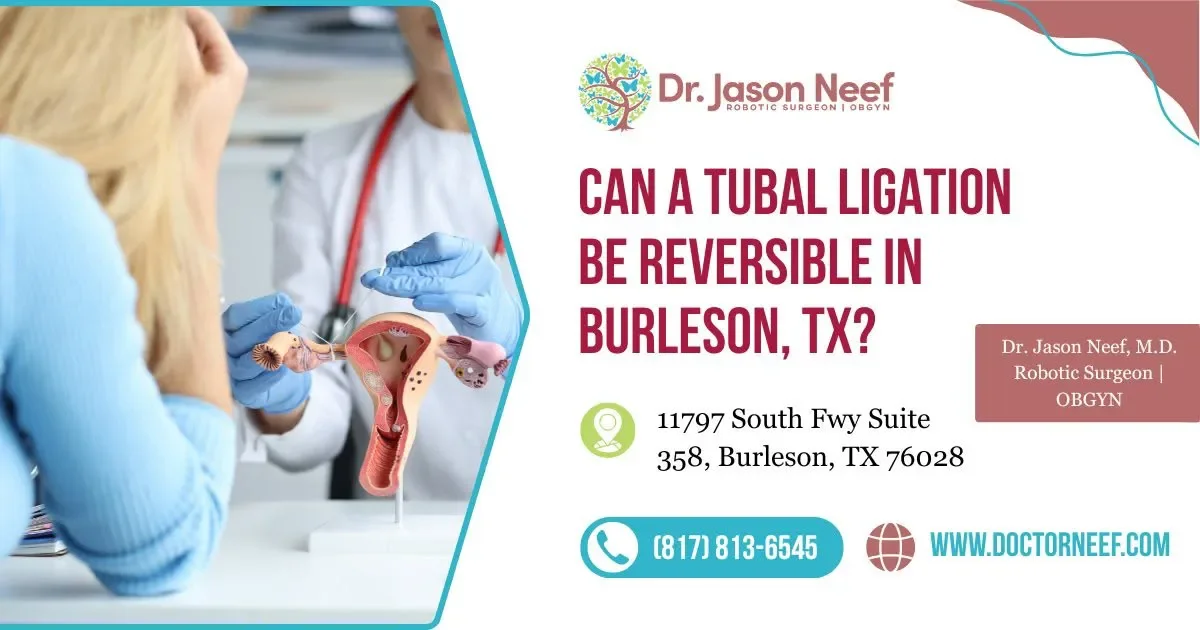
Most can, though not all. Whether reversal is possible depends primarily on how much healthy tube the original sterilization left behind, which varies substantially by method. Clips and rings typically damage a short segment and leave good candidates. Extensive cauterization can destroy enough tube to make reconnection impractical. Your operative report answers this more accurately than anything else.
Tubal ligation is described as permanent, and for most women it functions that way. What the word obscures is that reversal is frequently possible, and whether it is depends on specifics rather than on the general principle.
The determining factor is not usually age, time elapsed, or anything about your current health. It is what the original procedure physically did to your fallopian tubes. This guide covers which methods leave viable candidates, what makes a case unfavorable, and how to find out where you stand.
What Makes Reversal Possible
Reversal reconnects the separated segments of the fallopian tube, restoring the pathway between ovary and uterus. That requires two things.
Adequate healthy tube on both sides of the blocked or removed segment. The surgeon needs functional tissue to join, and enough total remaining length for the reconnected tube to work properly.
Tissue in usable condition. Scarred, thickened, or damaged tube may be present without being suitable for reconnection.
Both depend almost entirely on what the original sterilization did, which is why the method used matters more than any other single factor.
How Sterilization Methods Differ
| Method | What it does | Reversal outlook |
|---|---|---|
| Clips | Compresses a short segment | Generally favorable, minimal tube destroyed |
| Rings or bands | Loops and occludes a small section | Generally favorable |
| Partial salpingectomy with ties | Removes a segment, ties the ends | Depends on how much was removed |
| Cauterization, limited | Burns a defined section | Variable, depends on extent |
| Cauterization, extensive | Destroys longer sections | Frequently unfavorable |
| Complete salpingectomy | Removes the tubes entirely | Not reversible |
Clips and Rings
These methods occlude a short section of tube without destroying much tissue. When removed, they typically leave adequate healthy tube on both sides for reconnection.
Women whose sterilization used clips or rings are generally the most favorable candidates, sometimes regardless of how many years have passed.
Partial Removal With Ties
A segment is removed and the ends are tied. Whether reversal is feasible depends on how much was taken, which the operative report specifies.
Short removals frequently leave good candidates. Longer removals reduce the total remaining length, which affects both whether reconnection is possible and how well the reconnected tube functions.
Cauterization
Electrical current burns and seals the tube. The extent varies substantially between procedures and between surgeons.
Limited cauterization affecting a defined section can leave viable candidates. Extensive cauterization, sometimes burning multiple sections or long segments, can destroy enough tube that reconnection is not practical.
This is the method most likely to produce an unfavorable assessment, and also the one where the operative report matters most, since the extent is not predictable without it.
Complete Removal
Salpingectomy removes the fallopian tubes entirely. This cannot be reversed, because there is nothing remaining to reconnect.
Where complete removal was performed, IVF is the path to pregnancy, since it bypasses the tubes rather than requiring them.
Your Operative Report
This document determines the answer more reliably than anything else, and obtaining it should be the first step rather than something arranged after a consultation.
What It Contains
The operative report describes the method used, which segments were affected, how much tube was removed if any, and any complications or anatomical notes from the procedure.
That information lets a surgeon assess feasibility before you are in an operating room, which is considerably better than discovering the situation mid-procedure.
How to Obtain It
Request it from the facility where the sterilization was performed. Hospitals and surgical centers retain records for years, and the request typically takes a week or two.
If the facility has closed or records are unavailable, your surgeon can assess feasibility through imaging and, ultimately, during the procedure itself. That is workable but less informative than having the report.
What If You Do Not Remember the Method
Many women do not, particularly when the procedure occurred years ago or immediately after a delivery when other things were happening.
The report resolves this. Guessing does not, since the methods are not distinguishable by anything you would have experienced.
Other Factors Affecting Candidacy
Feasibility and likely success are related but distinct questions.
Feasibility asks whether reconnection is technically possible, and it depends on your tubes.
Likely success asks whether a successful reconnection would produce pregnancy, and it depends on age, ovarian reserve, and other fertility factors.
A woman can be an excellent candidate on the first question and a marginal one on the second, or the reverse. Both belong in the evaluation, and conflating them produces confusion.
Age and Ovarian Reserve
These do not affect whether reversal is technically possible. They affect what happens afterward, which is why they belong in the decision without belonging in the feasibility question.
Ovarian reserve testing for women over 35 provides individualized information that age alone cannot, and it is worth having before deciding.
Other Fertility Factors
Reversal addresses tubal blockage. Ovulation problems, endometriosis, uterine conditions, and male factor issues all persist afterward.
Evaluation before surgery prevents a frustrating year attributing unsuccessful attempts to the reversal when the constraint sits elsewhere.
Common Assumptions Worth Correcting
Several beliefs about reversibility circulate widely and lead women to rule themselves out unnecessarily or to expect more than is realistic.
That "permanent" means physically irreversible. The word describes intent and the fact that reversal requires surgery, not that reconnection is impossible. Most ligations can be reversed.
That too many years have passed. Elapsed time matters far less than method. Women conceive after reversals performed a decade or more after the original procedure.
That having it done after a delivery makes it different. Postpartum sterilization uses the same methods as interval procedures. What matters is which method, not when it was performed.
That a single consultation can determine feasibility without records. A surgeon can offer a general impression, and the operative report is what produces an actual assessment. Guessing wastes a consultation.
That being told no once settles it. Surgeons vary in experience with difficult reconnections, and a second opinion on the same operative report is reasonable rather than distrustful.
Weighing Reversal Against IVF
Where reversal is feasible, both options exist and the choice depends on your circumstances rather than on which is generally better.
What Reversal Offers
Restored natural fertility, permitting repeated conception attempts across subsequent years without further procedures. For women hoping for more than one child, that accumulated opportunity compounds.
It is a single surgery with a single recovery, after which conception happens without medical intervention.
What IVF Offers
Bypasses the tubes entirely, which makes it viable regardless of tubal condition. It works per cycle, providing a defined attempt with a known outcome within weeks rather than an open-ended trying period.
For women with limited time, declining ovarian reserve, or additional fertility factors, that per-cycle structure is frequently more efficient.
How to Decide
Age, tubal condition, other fertility factors, how many children you hope for, and cost across likely attempts all bear on it. A surgeon who explains both honestly, including when IVF would serve you better, is giving you what the decision requires.
What Happens During Assessment
A thorough consultation for reversal of tubal ligation covers several things.
Review of your operative report, which is the primary document. Assessment of your gynecologic history including prior surgery and any conditions affecting fertility. Discussion of your age and, where relevant, ovarian reserve. Evaluation of partner fertility. And an honest comparison against alternatives.
Some surgeons perform imaging to assess the tubes before surgery, though the operative report frequently provides more useful information than imaging can for this specific question.
What Reversal Surgery Involves
For women whose assessment comes back favorable, knowing what the procedure actually entails helps with making the decision.
The surgeon locates the blocked or separated segments, removes the damaged portion between them, and then reconnects the two healthy ends using very fine sutures placed under magnification. Several very fine sutures are typically placed at each join in order to create a watertight and correctly aligned connection between the two segments.
The fallopian tubes have an internal diameter narrower than a pencil lead, which is precisely why magnification and microsurgical technique matter here rather than being incidental technical detail.
Operating time varies considerably with how much reconstruction is required. A straightforward reconnection takes less time than a case involving significant adhesions or extensive scarring from the original procedure.
Most reversals are performed as outpatient procedures or with a single overnight stay, and the majority of women return to normal activity across the following two to three weeks.
If Reversal Is Not Feasible
An unfavorable assessment is disappointing and it is also useful information delivered before you have paid for a procedure that would not have worked.
IVF bypasses the tubes entirely, which makes it the standard path when reconnection is not possible. It works per cycle rather than restoring natural fertility, which changes the planning but not the possibility of pregnancy.
A surgeon who identifies infeasibility during evaluation and says so directly is doing the job properly. One who proceeds regardless is not, and the difference costs a great deal.
The Procedure Itself
Where reversal is feasible, the surgery reconnects the tube segments using very fine sutures, since the structures involved are narrower than a pencil lead.
That precision requirement is why technique matters. Robotic microsurgical technique provides magnified three-dimensional visualization and wristed instruments suited to the microsurgical suturing this repair requires.
Recovery is typically outpatient or a single overnight, with return to normal activity across two to three weeks. Conception attempts generally begin six to eight weeks afterward once healing is confirmed.
Texas Health Huguley Hospital in Burleson provides the facilities these procedures require, which keeps evaluation, surgery, and follow-up local.
Understanding what tubal ligation actually did in your case is where this starts. A Burleson robotic surgery practice can assess your operative report and give you a straight answer about candidacy, and women considering the procedure can book an assessment once they have obtained their records.
Key Takeaways
Most tubal ligations can be reversed, though not all. Feasibility depends primarily on how much healthy tube the original sterilization left behind rather than on age or elapsed time.
Clips and rings damage a short segment and generally leave favorable candidates. Extensive cauterization can destroy enough tube to make reconnection impractical.
Complete removal of the tubes cannot be reversed, since nothing remains to reconnect. IVF is the path to pregnancy in that situation.
Your operative report from the original sterilization is the document that answers this, and obtaining it should be the first step rather than something arranged afterward.
Feasibility and likely success are different questions. Your tubes determine whether reconnection is possible; your age and ovarian reserve determine whether it would produce pregnancy.
A surgeon who identifies infeasibility during evaluation and says so is doing the job correctly. Discovering it during surgery costs considerably more than a candid consultation would have.

Frequently Asked Questions
-
Most can, though not all. Feasibility depends on how much healthy tube the original sterilization left, which varies substantially by method. Clips and rings generally leave good candidates; extensive cauterization frequently does not.
-
Clips and rings, since they occlude a short segment without destroying much tissue. Partial removal with ties depends on how much was taken, and cauterization varies widely by extent.
-
No. Complete salpingectomy leaves nothing to reconnect. IVF bypasses the tubes and remains a path to pregnancy in that situation.
-
Somewhat, though considerably less than the method used. Many women conceive after reversals performed a decade or more later, and elapsed time is rarely the deciding factor by itself.
-
Request your operative report from the facility where the sterilization was performed. It specifies the method and extent, and it typically takes a week or two to obtain.
-
Your surgeon can assess feasibility through imaging and ultimately during the procedure itself. That is workable but less informative, which is why the report is worth pursuing first.
-
No. Age affects whether a successful reconnection would produce pregnancy, which is a separate question. The technical feasibility depends on your tubes rather than on your age.
-
Reversal addresses tubal blockage only. Ovulation problems, endometriosis, uterine conditions, and male factor issues all persist afterward, which is why evaluating them beforehand matters.
-
IVF becomes the standard path, since it bypasses the tubes entirely. An honest assessment before surgery is considerably better than discovering infeasibility during a procedure you have paid for.
-
Typically outpatient or a single overnight stay, with return to normal activity across two to three weeks. Conception attempts generally begin six to eight weeks later once healing is confirmed.
Conclusion
Tubal ligation is described as permanent, and for most women that description reflects intent rather than physical impossibility. Reversal is frequently achievable, and whether it is in your case depends on something specific and knowable: how much healthy tube the original procedure left behind. Clips and rings are generally favorable. Extensive cauterization frequently is not. Complete removal is not reversible at all.
That means the most useful thing you can do before any consultation is obtain your operative report from the facility where the sterilization was performed. It describes exactly what was done, which is information neither you nor a surgeon can reconstruct from memory or from examination. With that document in hand, a consultation becomes an assessment of your actual situation rather than a discussion of general possibilities, and you get a straight answer considerably sooner.
Find out what your original procedure actually left behind.
Book an assessment with Dr. Neef in Burleson.