How the Da Vinci Robotic Surgical System Works: A Patient's Guide
Categories:

By: Ethan Cole
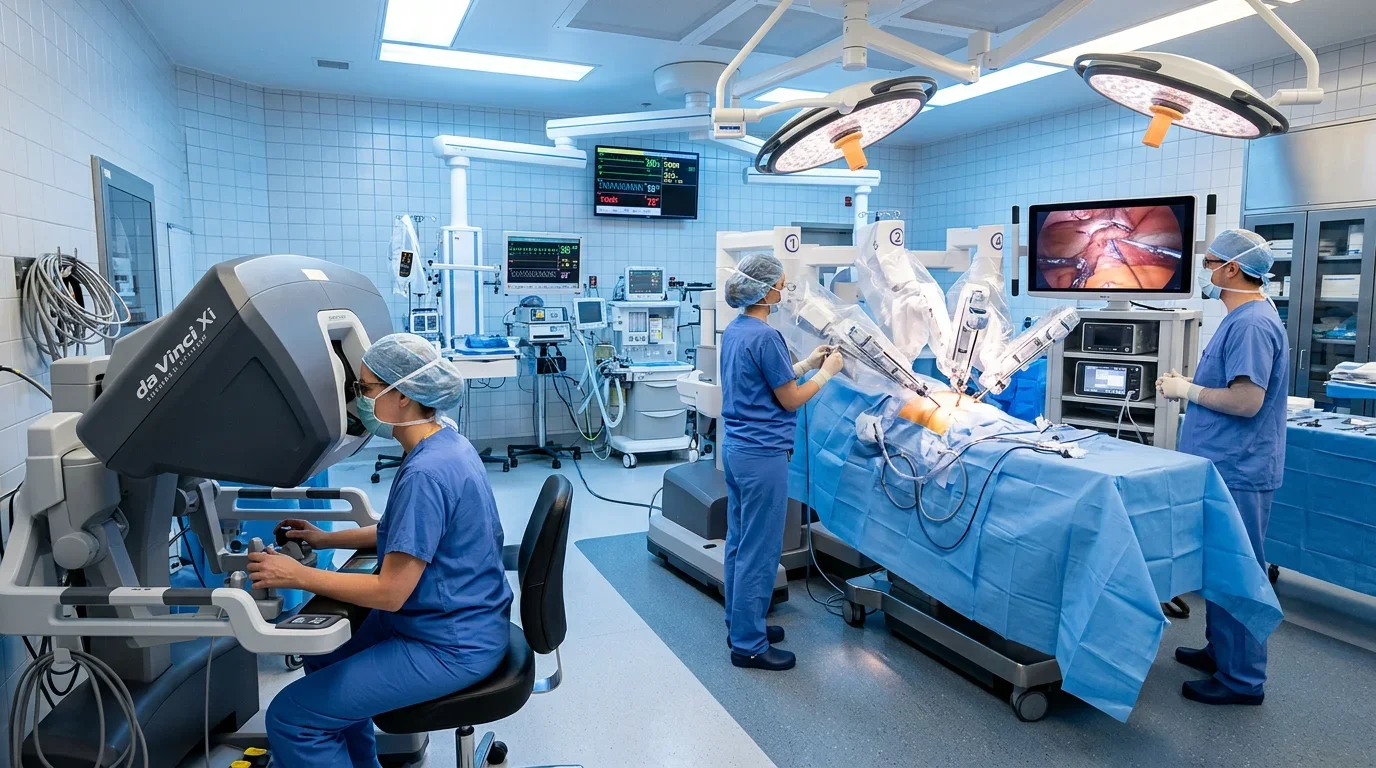
The Da Vinci surgical system is a surgeon-controlled robotic platform — not an autonomous robot. Your surgeon sits at a console a few feet away from you, looking through a 3D magnified viewpiece and controlling robotic arms that translate hand movements into ultra-precise micro-movements inside your body. The robot never makes independent decisions — every single movement comes from your surgeon's hands.
If your doctor has recommended robotic surgery and the word "robot" makes you nervous, you're in good company. The most common concern patients bring to their consultation is some version of "is a robot going to operate on me?" The short answer: no. Your surgeon operates on you, using the robot as a highly advanced tool.
This guide explains how the Da Vinci system actually works — in plain language, without the engineering jargon — so you can feel confident about the technology behind your procedure.
The Three Components: Console, Cart, and Vision
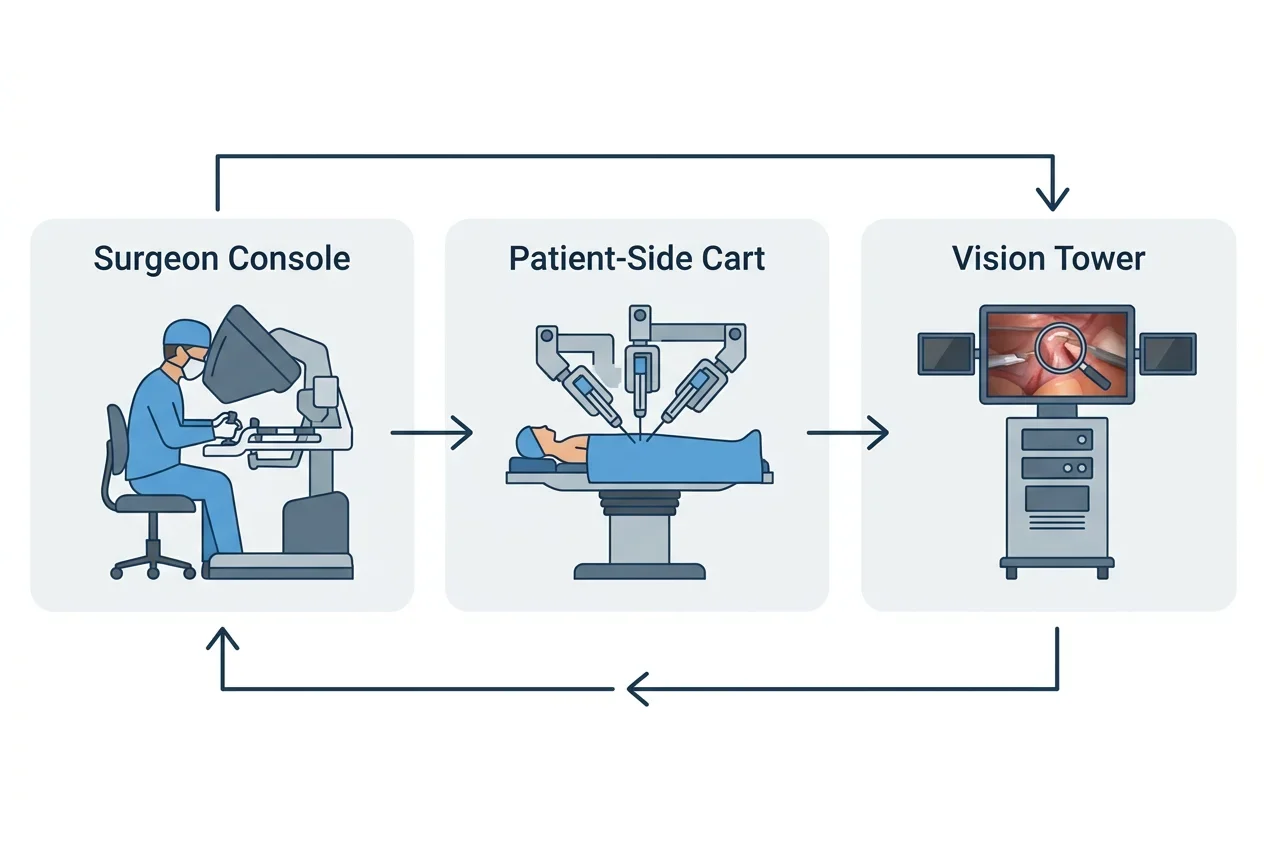
The Da Vinci system has three main parts that work together. The surgeon console is where your doctor sits and controls everything. The patient-side cart holds the robotic arms that perform the surgery inside your body. And the vision tower provides the magnified 3D view your surgeon sees while operating. These three components create a connected system where the surgeon's expertise is enhanced by robotic precision.
Think of it like this: the console is the steering wheel, the patient cart is the engine, and the vision tower is the windshield. They all work together, but the driver — your surgeon — is always the one making every decision and every movement.
The Surgeon Console. This is where Dr. Neef sits during your procedure — just a few feet from the operating table. He looks through a binocular viewpiece that displays a three-dimensional, high-definition image of your internal anatomy, magnified up to ten times normal size. His fingers rest on master controllers — ergonomic hand grips that sense his movements and translate them to the robotic instruments. The console also has foot pedals that control camera focus, energy devices, and instrument clutching. It's designed for comfort and focus, allowing the surgeon to operate for extended periods without the physical strain of traditional open surgery.
The Patient-Side Cart. This is the part you'll see in the operating room — a tower-like structure with three or four robotic arms that are positioned over your body through small port incisions. Each arm holds a different surgical instrument or camera. The arms don't move on their own — they only respond to what the surgeon does at the console. A surgical assistant is always positioned at your bedside alongside the patient cart throughout the entire procedure, monitoring your safety.
The Vision Tower. This component houses the image processing system that generates the 3D high-definition view your surgeon sees. It also displays the surgical view on monitors for the rest of the surgical team. The camera inserted through one of your incision ports captures two slightly offset images (like your two eyes do naturally), which are combined into a true stereoscopic 3D view — giving your surgeon depth perception that standard 2D laparoscopic cameras can't provide.
|
Component |
What It Does |
Where It Is |
Who Uses It |
|
Surgeon Console |
Surgeon controls all movements and views the 3D surgical field |
Near the operating table |
Your surgeon (Dr. Neef) |
|
Patient-Side Cart |
Robotic arms hold instruments and camera inside your body |
Directly over the operating table |
Responds only to surgeon's console commands |
|
Vision Tower |
Processes and displays magnified 3D HD images |
In the operating room |
Provides views for surgeon and surgical team |
|
Bedside Assistant |
Human team member at your side throughout surgery |
Next to you at the operating table |
Monitors safety, assists with instruments |
What Makes Robotic Instruments Different from Standard Surgical Tools?
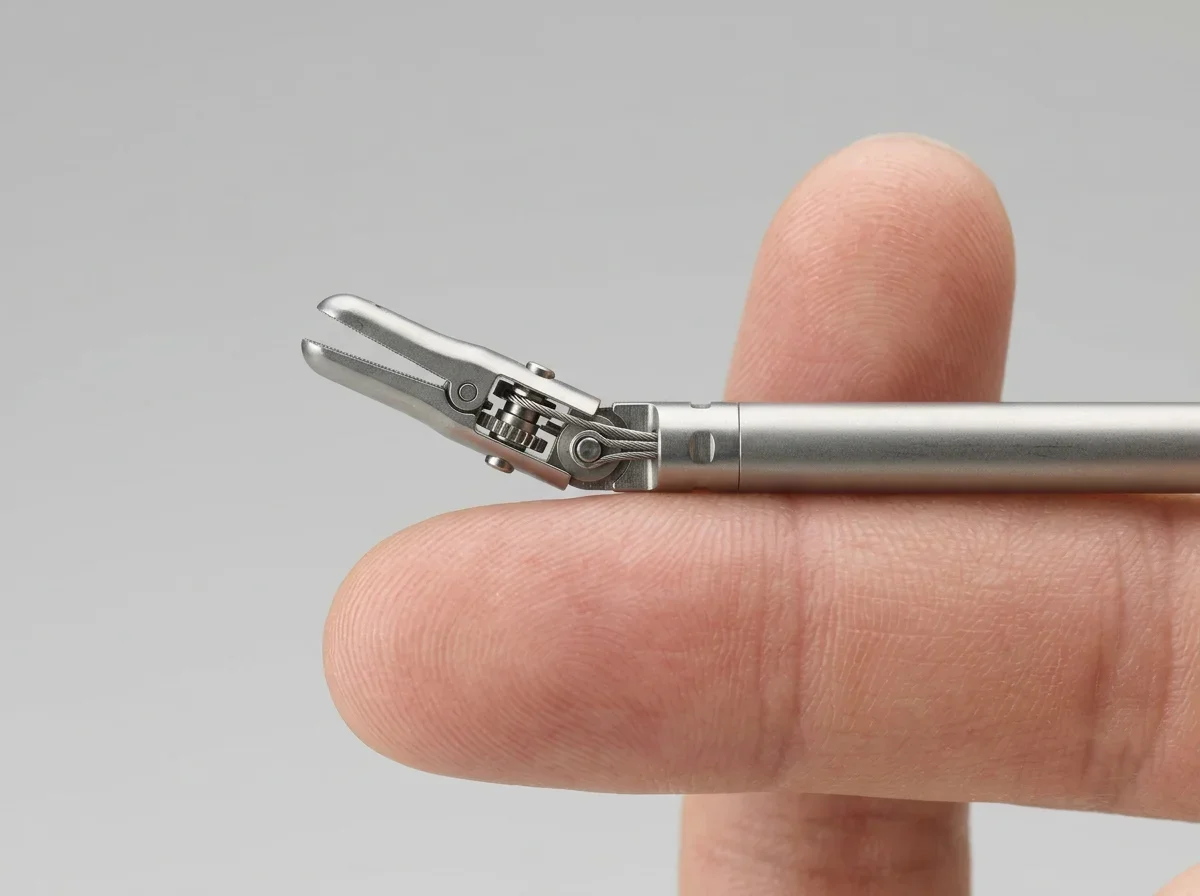
Da Vinci EndoWrist instruments have wristed tips that bend and rotate with seven degrees of freedom — greater range of motion than the human wrist. Combined with motion scaling (large hand movements become tiny instrument movements) and tremor filtration (natural hand shaking is eliminated), these instruments allow your surgeon to perform microsurgical tasks with a level of precision that manual techniques can't match.
Standard laparoscopic instruments are essentially long, rigid sticks with a tool on the end. They can open, close, and rotate — but they can't bend mid-shaft or articulate like a wrist. This limits what a surgeon can do in tight anatomical spaces. Imagine trying to tie a knot inside a box using two straight chopsticks — possible, but extremely difficult and imprecise.
Da Vinci instruments change that equation entirely. Each instrument tip has a built-in wrist joint that articulates in multiple directions — mimicking the natural movements of a human hand but at a much smaller scale. This "wristed" capability means the instruments can reach around corners, approach tissue from angles that rigid instruments can't achieve, and perform delicate suturing motions that are essential for procedures like tubal reanastomosis and Essure reversal.
Motion scaling is another feature patients don't hear much about, but it's critical for microsurgery. When Dr. Neef makes a one-inch movement at the console, the system can translate that into a quarter-inch movement at the instrument tip (or smaller, depending on the scaling ratio). This means the surgeon can make broad, comfortable hand movements while the instruments perform tiny, precise actions inside your body. It's like having a built-in magnifying glass for your hands.
Tremor filtration eliminates the natural micro-vibrations that every human hand produces. Even the steadiest surgeon has physiological tremor — tiny oscillations that are invisible to the naked eye but can affect microsurgical accuracy. The Da Vinci system filters these out electronically, so the instrument tips move with computer-smoothed precision.
For gynecologic procedures specifically, these capabilities matter because the pelvic anatomy involves small structures (fallopian tubes, blood vessels, ureters) in confined spaces. The ability to work with wristed instruments, scaled movements, and tremor-free precision in these areas translates directly to better surgical outcomes — less tissue damage, less bleeding, and more accurate repair work.
|
Instrument Feature |
What It Means |
Why It Matters for You |
|
EndoWrist Articulation |
Tips bend and rotate like a wrist |
Surgeon reaches tight spaces your pelvis with full dexterity |
|
7 Degrees of Freedom |
Movement in every direction |
Greater range of motion than a human wrist |
|
Motion Scaling |
Large hand moves become micro-instrument moves |
Ultra-precise suturing and tissue handling |
|
Tremor Filtration |
Removes natural hand vibrations |
Smoother, steadier instrument movements |
|
Instrument Diameter |
~8mm — smaller than a pencil |
Fits through tiny incisions, minimal tissue disruption |
|
Interchangeable Tips |
Different tools for cutting, grasping, suturing, cauterizing |
Right tool for each surgical task without additional incisions |
Your Surgeon Is Always in Control: Addressing the "Robot" Concern
The Da Vinci system has no artificial intelligence, no autonomous programming, and no ability to make surgical decisions. It is a tool — controlled entirely by your surgeon's training, judgment, and hand movements. If the surgeon stops moving, the robot stops moving. If the surgeon removes their head from the viewpiece, the system locks and instruments cannot move. Every safety feature is designed to keep the surgeon firmly in charge.
Let's address the elephant in the operating room. The word "robotic" in robotic surgery makes it sound like a machine is performing your procedure. Pop culture has conditioned us to imagine autonomous robots making independent decisions. The Da Vinci system is nothing like that.
Here's what actually happens: the system is a sophisticated extension of your surgeon's hands and eyes. It doesn't plan. It doesn't decide. It doesn't suggest. It doesn't override. It translates — converting your surgeon's physical inputs into precise mechanical outputs. That's it. The intelligence behind every surgical decision comes from Dr. Neef's training at UT Houston and UT Southwestern, his years of experience since 2008, and his real-time assessment of your unique anatomy during the procedure.
The system also has multiple built-in safety mechanisms. If the surgeon lifts their head away from the console viewpiece, the instruments immediately lock in place — they cannot move until the surgeon re-engages. The system performs constant self-diagnostics during surgery, alerting the team to any mechanical issues. And a trained surgical assistant is always at your bedside, providing an additional layer of human oversight throughout the operation.
One way to think about it: the Da Vinci system is to surgery what power tools are to carpentry. A circular saw doesn't build a house — a skilled carpenter does. The saw just makes certain cuts more precise, more efficient, and more consistent than a hand saw. Similarly, the Da Vinci doesn't perform your surgery — Dr. Neef does. The system makes certain aspects of the surgery more precise, more controlled, and more consistent than manual techniques alone.
Key Takeaways
The Da Vinci system is surgeon-controlled — it has no AI and no autonomy. Every movement comes directly from your surgeon's hands at the console.
Three components work together: the surgeon console (where your doctor controls everything), the patient-side cart (robotic arms with instruments), and the vision tower (3D magnified display).
EndoWrist instruments provide wristed articulation with seven degrees of freedom — more range of motion than a human wrist in a space smaller than a pencil diameter.
Motion scaling and tremor filtration translate normal hand movements into ultra-precise micro-movements while eliminating natural hand vibrations.
Multiple safety mechanisms prevent any uncontrolled movement — including auto-lock when the surgeon disengages from the viewpiece and continuous system self-diagnostics.
Your surgeon's expertise drives everything — the robot enhances precision and visualization, but every decision and every movement originates from your surgeon.
What This Means for Your Gynecologic Procedure
For patients undergoing tubal reversal, Essure reversal, or hysterectomy with Dr. Neef, the Da Vinci system means your surgery is performed through tiny incisions with magnified 3D visualization and robotic precision — resulting in less pain, faster recovery, smaller scars, and outcomes that match or exceed what traditional approaches can achieve.
The practical impact on your experience comes down to a few key things. Smaller incisions mean less pain and faster healing. Better visualization means your surgeon sees more detail and can work more accurately. Robotic precision means delicate structures like fallopian tubes and blood vessels are handled with greater care. And all of it adds up to getting you home sooner and back to your life faster.
Dr. Neef has been using the Da Vinci system for gynecologic procedures at Texas Health Huguley Hospital in Burleson since establishing his practice there. His familiarity with the platform — combined with his specialized training in reproductive microsurgery — means you're getting both the best technology and the experienced hands guiding it.
Questions about the Da Vinci system or your upcoming robotic procedure? Schedule a consultation with Dr. Neef — get your questions answered by the DFW expert.
Call (817) 568-8731Categories:


Frequently Asked Questions
-
No. The Da Vinci system has no artificial intelligence and makes zero autonomous decisions. Every movement is a direct translation of your surgeon's hand movements at the console.
-
The system performs continuous self-diagnostics. If any issue is detected, the surgical team is immediately alerted. In the extremely rare event of a system issue, your surgeon can convert to standard laparoscopic or open surgery to safely complete the procedure.
-
Yes. The surgeon console is located in the same operating room, just a few feet from the operating table. A surgical assistant is also at your bedside throughout the entire procedure.
-
The Da Vinci system has been in clinical use for over two decades. Millions of procedures have been performed worldwide across multiple surgical specialties including gynecology, urology, cardiac surgery, and general surgery.
-
For patients, the out-of-pocket cost is typically comparable because the procedure codes and insurance billing are similar. The hospital's investment in the technology doesn't usually increase the patient's share.
-
No. Surgeons must complete specialized training and certification to operate the Da Vinci system. Not every gynecologist has this training, which is why the robotic surgeon approach isn't universally available.
-
Typically four to five incisions, each between 5mm and 12mm — roughly the size of a pencil eraser to a dime. These are closed with dissolvable stitches and fade to nearly invisible marks within months.
-
The Da Vinci system is suitable for most gynecologic surgeries, though not all conditions require it. Dr. Neef evaluates each patient individually to determine whether the robotic approach offers advantages for their specific procedure.
-
The camera system creates true stereoscopic depth perception — like seeing with both eyes versus one. This gives your surgeon the ability to judge distances and tissue layers more accurately than with a standard 2D laparoscopic camera.
-
During your consultation, Dr. Neef can explain the system in detail and answer any questions about the technology. Some patients find that understanding the system beforehand significantly reduces pre-surgery anxiety.