Robotic Essure Reversal: Complete Guide to Removal and Fertility Restorati
Categories:

By: Ethan Cole

Robotic Essure reversal is a specialized surgical procedure that removes the Essure sterilization device from your fallopian tubes and reimplants the tubes into the uterus, restoring your natural ability to conceive. Only a handful of surgeons nationwide perform this procedure robotically — making it a rare but highly effective option for women who want their Essure reversed for fertility or symptom relief.
If you had Essure placed and now regret the decision — whether because you want to get pregnant, you're experiencing complications, or both — you're not alone. Thousands of women have sought Essure reversal surgery since the device was discontinued by Bayer in 2018 after years of reported complications and an eventual market withdrawal.
This guide covers everything you need to know: the difference between Essure removal and reversal, how the robotic procedure works, what recovery looks like, what fertility outcomes you can expect, and how to find a qualified surgeon for this highly specialized operation.
What Is the Difference Between Essure Removal and Essure Reversal?
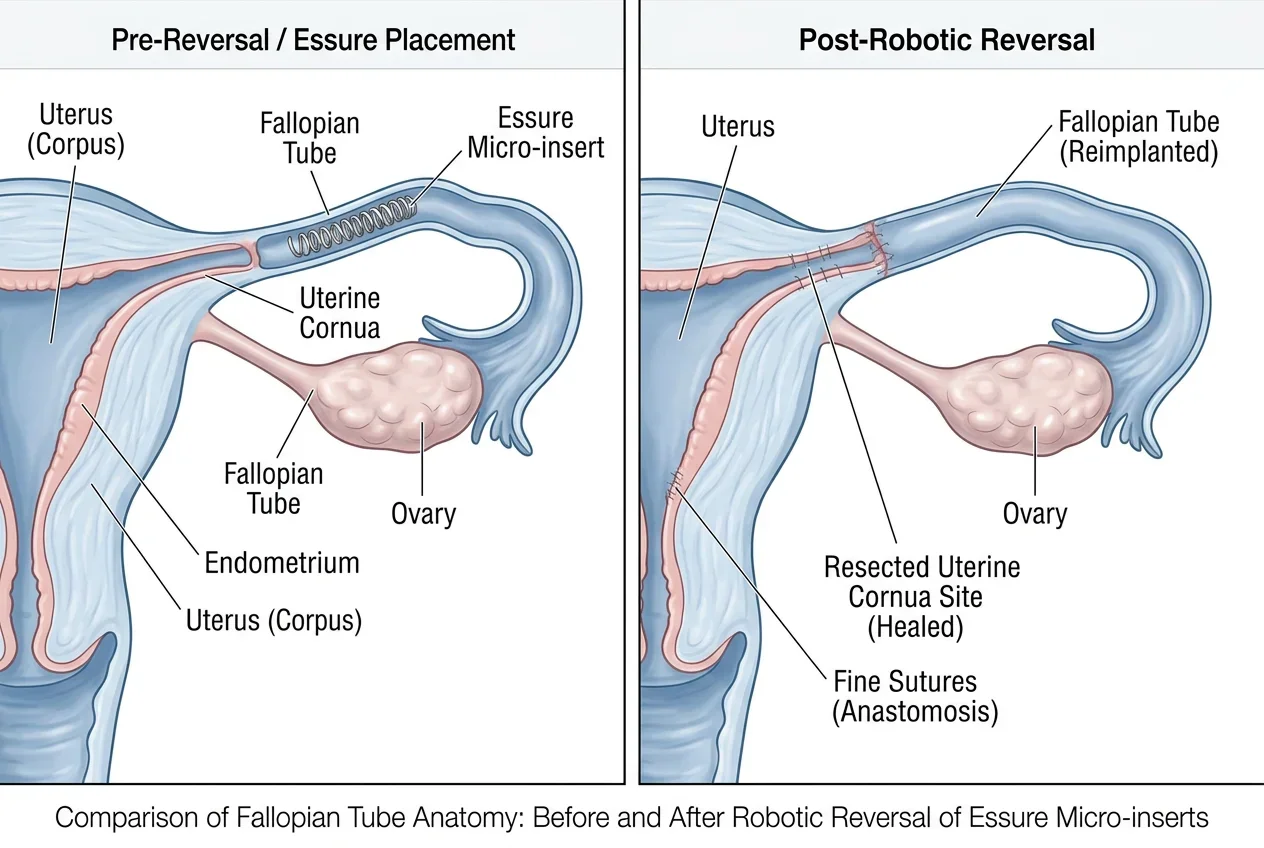
Essure removal extracts the coils from your fallopian tubes — typically to relieve symptoms like pain, fatigue, or allergic reactions. Essure reversal goes further: it removes the device, resects the damaged portion of the uterine cornua, and reimplants the remaining healthy fallopian tube back into the uterus to restore fertility. Removal addresses symptoms; reversal addresses symptoms AND restores your ability to conceive.
This distinction is critical because many patients — and even some doctors — use these terms interchangeably. They're not the same procedure, and the one you need depends on your goals.
Essure removal is the simpler of the two. A surgeon removes the coils from the fallopian tubes, sometimes laparoscopically or hysteroscopically. The procedure takes roughly 30-45 minutes and is typically done to address complications — chronic pelvic pain, nickel allergic reactions, device migration, or other symptoms attributed to the Essure inserts. After removal, the fallopian tubes are usually no longer functional for fertility because of the scar tissue that formed around the coils.
Essure reversal is a more complex and specialized procedure. The surgeon doesn't just remove the coils — they resect the portion of the uterine cornua (the corner of the uterus where the tube connects) that contains the embedded device and surrounding scar tissue. Then, the remaining healthy fallopian tube is carefully reimplanted into the uterus and sutured in place. This creates a new connection between the tube and the uterine cavity, potentially restoring the pathway for eggs to travel from the ovary to the uterus.
The robotic approach is particularly valuable for Essure reversal because the uterine cornua is a tight, complex anatomical space. The Da Vinci system's wristed instruments and 3D magnification give the surgeon the precision needed to resect the damaged tissue and reimplant the tube without compromising the surrounding uterine wall. This level of microsurgical control is exactly what makes the robotic surgical approach superior for this specific procedure.
|
Factor |
Essure Removal Only |
Essure Reversal (Robotic) |
|
Goal |
Symptom relief |
Symptom relief + fertility restoration |
|
What's Done |
Coils extracted from tubes |
Coils removed, cornua resected, tube reimplanted |
|
Fertility After |
Unlikely — tubes remain blocked by scar tissue |
Possible — tube reconnected to uterus |
|
Procedure Time |
30-45 minutes |
~2 hours |
|
Complexity |
Moderate |
High — requires specialized robotic training |
|
Surgeons Who Perform It |
Many gynecologic surgeons |
Very few nationally |
|
Recovery |
~1 week |
~2 weeks |
If your primary goal is to get pregnant after Essure, you specifically need the reversal procedure — not just removal. And the number of surgeons who can perform this robotically is extremely small. Dr. Jason Neef, MD, is one of only a few doctors nationally trained to perform robotic Essure reversal using the Da Vinci platform.
How Does the Robotic Essure Reversal Procedure Work?
During robotic Essure reversal, Dr. Neef sits at the Da Vinci console and uses robotic arms to carefully remove each Essure coil along with the scarred portion of the uterine cornua, then microsurgically reimplants the remaining healthy fallopian tube into the uterus. The procedure takes approximately two hours and is performed through four to five tiny abdominal incisions.
Let's walk through what actually happens in the operating room. Understanding the surgical steps can ease a lot of the anxiety that comes with committing to a procedure this specialized.
You'll be placed under general anesthesia — you won't feel anything during surgery. Once you're asleep, the surgical team positions the Da Vinci patient-side cart, and the robotic arms are docked to four to five small port incisions (each 5-12mm) on your lower abdomen. A high-definition 3D camera is inserted through one port, giving Dr. Neef a magnified view of your pelvic anatomy.
The first surgical step is identifying and exposing the Essure devices within the fallopian tubes and uterine cornua. Each Essure coil is embedded in scar tissue that formed intentionally after placement — that's how Essure achieved sterilization. The challenge is that this scar tissue extends into the uterine wall, making simple extraction impossible without damaging the surrounding tissue.
Dr. Neef resects a small wedge of the uterine cornua containing the entire Essure device and all associated scar tissue. This is the most technically demanding part of the procedure — the resection must be precise enough to remove all of the device material while preserving as much healthy uterine wall as possible. The Da Vinci system's motion scaling and tremor filtration are critical here, allowing millimeter-precision cuts in a space barely larger than a marble.
After the device is completely removed, the remaining healthy fallopian tube is prepared and reimplanted into the newly created opening in the uterus. Fine microsurgical sutures secure the tube in place, creating a new connection between the fallopian tube lumen and the uterine cavity. This tubouterine implantation is what differentiates reversal from simple removal — it's what gives you a chance at natural pregnancy.
|
Surgical Step |
What Happens |
Time |
|
Anesthesia & Port Placement |
General anesthesia, 4-5 small incisions, robotic arms docked |
20-30 min |
|
Essure Identification |
Camera locates devices within fallopian tubes and cornua |
10-15 min |
|
Cornual Resection |
Wedge resection removes device + scar tissue from uterine corner |
30-40 min |
|
Tube Reimplantation |
Healthy fallopian tube sutured into new uterine opening |
30-40 min |
|
Closure |
Incisions closed with dissolvable stitches |
10-15 min |
The entire procedure takes about two hours. You'll wake up in the recovery room and, after monitoring, are typically discharged the following day. The Essure removal surgery portion alone is relatively quick — it's the reimplantation and microsurgical reconnection that require the additional time and robotic precision.
What Does Recovery Look Like After Robotic Essure Reversal?

Recovery from robotic Essure reversal takes approximately two weeks — longer than a simple Essure removal because the procedure involves cornual resection and tube reimplantation. Most patients manage pain with prescription medication for the first few days, then transition to over-the-counter NSAIDs. You'll have dissolvable stitches and small incisions that heal with minimal scarring.
The two-week recovery timeline for Essure reversal is longer than the one-week recovery for robotic tubal reversal, and there's a good reason for that. The cornual resection — removing a portion of the uterine wall — is more invasive than simply reconnecting already-existing tube segments. Your uterus needs time to heal at the reimplantation site before it's safe to resume full activity.
Here's what the first few days look like. Day one post-surgery is the hardest. You'll feel groggy from anesthesia and sore around the incision sites. Expect some abdominal bloating from the CO2 gas used during laparoscopy — this usually resolves within 48 hours as your body absorbs the gas. Dr. Neef provides a prescription for pain medication to keep you comfortable.
By day three or four, most patients notice significant improvement. The bloating subsides, incision soreness decreases, and you can move around the house, eat normal meals, and handle light self-care activities. Many patients transition from prescription pain meds to ibuprofen or naproxen by this point. Walking is encouraged — short, gentle walks help your body heal and reduce gas discomfort.
Week two is about graduating back to normal life. Most patients return to desk work or light-duty jobs by the end of the second week. Heavy lifting (anything over 15 pounds), intense exercise, and sexual activity should wait until Dr. Neef clears you at your follow-up appointment. Your incisions will be healing well by this point — small, clean marks that fade significantly over the coming months.
For patients pursuing Essure reversal specifically for symptom relief (pain, fatigue, allergic reactions), many report noticeable improvement in their symptoms within the first few weeks. The removal of the nickel-titanium coils eliminates the source of irritation, and as your body heals from surgery, many of the chronic symptoms that prompted the procedure begin to resolve.
If fertility is your goal, you'll discuss conception timing with Dr. Neef at your follow-up. Because the uterine wall was resected and repaired, there may be a recommended waiting period before actively trying to conceive — your surgeon wants to ensure the reimplantation site has healed fully before a pregnancy puts any stress on the uterine wall.
Key Takeaways
Essure removal and Essure reversal are different procedures — removal extracts the coils for symptom relief, while reversal also reimplants the fallopian tubes to restore fertility.
Robotic Essure reversal requires cornual resection — the surgeon removes a wedge of the uterine corner containing the device and scar tissue, then reimplants the healthy tube.
Only a few surgeons nationally perform robotic Essure reversal. Dr. Neef is one of the only physicians in the country trained to do this on the Da Vinci platform.
Recovery takes approximately two weeks, longer than simple removal because the uterine wall must heal at the reimplantation site.
Both symptom relief and fertility restoration are possible outcomes, depending on your goals and the extent of your procedure.
The Da Vinci system's precision is essential for the tight uterine cornua work required — 3D magnification and wristed instruments enable microsurgical accuracy in a very small space.
Can You Get Pregnant After Essure Reversal? What the Outcomes Show
Pregnancy after robotic Essure reversal is possible, though success rates vary based on factors including your age, the condition of your remaining fallopian tubes, and the extent of scar tissue that formed around the Essure devices. The FDA removed Essure from the market in 2018 after extensive reports of complications, but for women who still have the device, reversal offers a path to natural conception.
Here's what you should understand about fertility expectations after Essure reversal. This procedure is newer and more complex than traditional tubal ligation reversal, which means the body of outcome data is smaller. But the results that do exist are encouraging — particularly for younger patients with healthy reproductive systems.
The core variable is how much healthy fallopian tube remains after the cornual resection and reimplantation. Essure devices extend into the tube and cornua, and the scar tissue they generate can involve a significant length of the proximal (uterus-end) tube. The more healthy tube Dr. Neef can preserve during resection, the better the fertility outlook.
Age remains the most important factor — as it does with any fertility procedure. Women under 35 generally have the best outcomes. Women 35-40 can still achieve pregnancy, but rates decrease. Over 40, success becomes less likely, and alternative options like IVF may be discussed.
The timeline for conception after Essure reversal is also important to set expectations around. Unlike tubal ligation reversal where patients can often begin trying within a few weeks, Essure reversal patients may need to wait a bit longer for the uterine reimplantation site to fully heal. Your specific timeline will be determined by Dr. Neef based on how your surgery went and how your healing progresses.
For women pursuing Essure reversal primarily for symptom relief rather than fertility, the good news is even clearer. Most patients experience significant improvement in their symptoms — pelvic pain, headaches, fatigue, joint pain, and nickel sensitivity reactions — within weeks of having the devices removed.
Take control of your health — explore robotic Essure reversal with Dr. Neef. Schedule your Essure reversal consultation today — one of the few specialists in the country who can help.
Call (817) 568-8731Categories:


Frequently Asked Questions
-
Yes. Essure reversal involves removing the device, resecting the scarred uterine cornua, and reimplanting the fallopian tube into the uterus. While Essure was designed to be permanent, skilled robotic surgeons can reverse the sterilization in many cases.
-
No. Removal simply extracts the coils — usually for symptom relief. Reversal goes further by reimplanting the fallopian tubes to restore the possibility of natural pregnancy. They're different procedures with different goals and complexity levels.
-
The procedure typically takes about two hours. You'll be under general anesthesia, and most patients are discharged the following day from Texas Health Huguley Hospital in Burleson.
-
Dr. Jason Neef, MD, is one of only a few surgeons nationally who performs robotic Essure removal surgery and Essure reversal using the Da Vinci platform. He practices at Texas Health Huguley Hospital in Burleson, TX, serving the entire DFW metroplex.
-
Costs vary depending on the complexity of the procedure and whether it's covered by insurance. Essure removal for documented complications may qualify for insurance coverage. Contact Dr. Neef's office for specific pricing and financing options.
-
Many patients report significant improvement in chronic pelvic pain, fatigue, headaches, and allergic symptoms after the Essure devices are removed. The timeline for symptom resolution varies, with most improvement occurring within the first several weeks.
-
The procedure is performed through small 5-12mm incisions, resulting in significantly less pain than open surgery. Most patients manage with prescription pain medication for the first two to three days, then transition to over-the-counter NSAIDs.
-
Pregnancy is possible after a successful Essure reversal. The procedure reimplants the fallopian tubes to restore the natural pathway for conception. Success depends on age, tube condition, and overall reproductive health.
-
Many general gynecologists aren't trained in Essure reversal and may tell you it's impossible. A consultation with a specialist like Dr. Neef — who has specific training and experience in this procedure — can give you an accurate assessment of your candidacy.
-
Call Dr. Neef's office at 817-568-8731 to schedule a consultation. Bring your Essure placement records and any relevant medical history. Virtual consultations are also available for out-of-town patients considering travel to Burleson for the procedure.